we lit it up

Congrats to my fab friend Kate Brauning and her debut HOW WE FALL releasing tomorrow! I’m at the #YAlaunch retreat right now (and we’re having our twitter party tonight!!) so expect a post on that later this week (there were recorders, dinosaurs, and #OmahaCityofDreams is now a Thing, yo).

In the mean time, please enjoy riding along on Kate’s book blast for HWF:

How We FallHow We Fall
Kate Brauning
Merit Press, F&W Media
Releasing November 11, 2014
Hardcover: 304 pages
ISBN-10: 1440581797
ISBN-13: 978-144058179

Ever since Jackie moved to her uncle’s sleepy farming town, she’s been flirting way too much–and with her own cousin, Marcus.

Her friendship with him has turned into something she can’t control, and he’s the reason Jackie lost track of her best friend, Ellie, who left for…no one knows where. Now Ellie has been missing for months, and the police, fearing the worst, are searching for her body. Swamped with guilt and the knowledge that acting on her love for Marcus would tear their families apart, Jackie pushes her cousin away. The plan is to fall out of love, and, just as she hoped he would, Marcus falls for the new girl in town. But something isn’t right about this stranger, and Jackie’s suspicions about the new girl’s secrets only drive the wedge deeper between Jackie and Marcus.

Then Marcus is forced to pay the price for someone else’s lies as the mystery around Ellie’s disappearance starts to become horribly clear. Jackie has to face terrible choices. Can she leave her first love behind, and can she go on living with the fact that she failed her best friend?

Praise for How We Fall:

Kirkus Reviews: “Debut novelist Brauning tells a touching story of young, star-crossed lovers caught in a drama they have tried hard to avoid…. A sweetly written mix of mystery and romantic turmoil.”

School Library Journal: “Heartbreaking and well-paced, this mystery novel challenges readers to look past preconceptions and get to the know characters, rather than focus on an uncomfortable taboo. Brauning’s characters are well developed and their story engrossing. An intriguing thriller… this title will raise eyebrows and capture the interest of teens.”

ALA Booklist: “…an unusual combination of romance and suspense…There is also something universal about Jackie’s struggles with her feelings and her desires, and readers will identify with her emotions, while going along for the plot’s ride. This quest for identity, wrapped up in an intriguing mystery, hooks from the beginning.”

How We Fall is available through:

Barnes & Noble Indie Bound Walmart.com Book-A-Million Book Depository Powell’s

Amazon.com Amazon.ca Amazon.co.uk

All book lovers are invited to attend #YAlaunch, a giant book party for How We Fall and The Hit List on Monday, November 10th, from 6-9pm central time. Broadcast live over video, the party will allow you to see, hear, and interact with the authors. 10 YA and adult authors will be discussing everything from writing a series to how they write love interests. They’ll also be playing book games with the audience, taking questions, and giving away 100 books to guests attending online. Authors attending include NYT bestsellers Nicole Baart and Tosca Lee, Kate Brauning, Nikki Urang, Kiersi Burkhart, Bethany Robison, Alex Yuschik, Blair Thornburgh, Kelly Youngblood, and Delia Moran. It will be a fun and interactive evening for anyone who loves books and wants to spend some time with great authors. For more information and to sign up to attend, please click here. We’d love to see you there!

Author Bio:www.jenniophotography.com

Kate Brauning grew up in rural Missouri and fell in love with young adult books in college. She now works in publishing and pursues her lifelong dream of telling stories she’d want to read. This is her first novel. Visit her online at http://www.katebrauning.com or on Twitter at @KateBrauning.

spreading threads of thunder

When I was eight years old, I went to Nantucket with my family and my best friend’s family. We took a boat, and on the trip she took out a yellow GameBoy Color, started playing this game you maybe have heard of called Pokemon Blue, and let me try it.

Everything changed.

I’d gotten really bored with television– I hated (and continue to hate) episodic series where any order is as good as any other (I’m looking at you, Nickelodeon). The way kid me described it was that I wanted a movie that I could push along at my own pace. When I started playing that Pokemon game, I’d found what I was looking for: a story that I made happen only through my effort.

My parents were not gamers. They were actually pretty against games, and I had to work my ass off convincing them I’d still do all my homework, agreeing if I fell behind on any chores or assignments or showed signs of being irresponsible that they’d take the game away. They also wouldn’t buy it for me– part of the deal was that if I wanted it so badly, I had to earn it myself.

Which was actually pretty awesome, because it was one of the best and earliest lessons in responsibility I got as a kid: if you want something, you have to work to achieve it and plan how you’re going to fit it into your life once you have.

It was $70 for the GameBoy Color, $20 for Pokemon Blue, so $95 total. I did odd jobs around the house, weeded, dusted, cleaned bathrooms, etc. It took around three or four weeks from the time when me and my parents drew up the agreement to when I finished earning the money for it. Now that I’m older, I think maybe they were banking on the fact that I tend to be very ambitious and start lots of stuff, only finishing the ones I was serious about.

But I was serious about this one. I wanted to have stories whose fates depended on my active input, movies whose endings rested on my shoulders instead of being drawn to some inevitable conclusion. I wanted to be the one who made the endings happen.

And so, that’s what I became.

This isn’t to convince you that I’m a legit gamer. Personally, I think that “legit gamer” status is bullshit– if you play a video game and enjoy it, congrats! Yer a gamer, Harry.

I’m telling you this because I want you to see that this has been a large part of my identity since I was a kid. It’s integral to how I write and how I develop magic systems and build worlds. Part of the reason I do math is that I also see it as a type of game.

And still, I wasn’t going to post this. It’s more exhausting writing about something you dislike than it is to just say “nope, you know what, we’re not going to go there because that is one whole-ass mess of crazy and I’d rather play Animal Crossing and have fun than buy a slice of that, thanks.”

But then I read stuff like this on my timeline:

and I’m like, welp, how can I be silent when it’s exactly what those GG guys want?

My speaking out about stuff like this doesn’t reach a large number of people. I know that. In the long run, writing this post will probably make me more uncomfortable than it will anyone reading it. But that’s okay, because I think I’d be disappointed in myself if I didn’t state this publicly at least once.

I’m a girl and I play games. And it bothers the hell out of me that my mostly kickass video game culture (because hey, we’re humans and there will always be some level of douchebaggery everywhere) is having such trouble reconciling that people like me exist and both impact and deserve to impact that culture.

And the thing is, I love games and the fantastic worlds within them too much to stop playing. I am going kind of nuts trying to figure out whether I want to buy Pokemon Alpha Sapphire or Omega Ruby first (also lol, you have no idea how hilarious it’s been talking about ye olde GBC instead of the 3DS). I’ve already warned my family that around Thanksgiving I’m going to be making my yearly pilgrimage through Persona 3, and I’m forever going to fawn over every member of the Namco Tales series (even though yeah Legendia was kind of odd).

I’ve gone through packs of AA batteries like an alkaline junkie. I barbaric yawp’d and scared the neighbors when my handheld consoles finally switched to chargers. I got asked to beat all the hard levels for my little brother, which I did because I’m good at puzzles and half-decent at being a sibling. I’ve delayed more family dinners with “I’m not at a savepoint yet!” than most people sit down to in a year.

I’ve loved these things since I was eight years old and tromping around on a chilly boat supposedly watching whales, actually watching Charmander fight Brock’s Onix in Pewter Gym.

I’m in it for the adventure and the stories, and that’s not going to change.

But the next time you see that hashtag pop up and you wonder if you really know anyone affected by all this madness, if any of us are biting our nails and delaying pressing post as long as humanly possible because damn it’s gotten terrifying to even identify as a member of this community if you’re female or if it’s all just conflated SJW nonsense, then: hi.

I’m a girl, and I play games.

ghosts

5am is my favorite time of the day.

It’s that half-lit time between night and morning, stupidly early before the rest of the world wakes up. And I’m in a coffeeshop, working on a manuscript.

Once when I was in undergrad, one of my poetry professors said that he only submitted to literary magazines whose titles intrigued him (I have tried to follow his example, because it’s nine million times more fun to say “oh yes, I’m in Print-Oriented Bastards“) and he said that he and some friends worked on and called one 5AM for the similar reasons: because if you’re awake at 5am, you’ve got to have a reason for it– you’re either out too late chasing the wild party, or you have a very specific job.

The latter group is the one I most often roll with, and it’s where the protagonist for this new story falls. This is a thing I started writing in high school, finished a draft of in college, and that I’m rewriting for the first time since 2012.

My last manuscript, SLINGS AND ARROWS, has a whole lot to do with ghosts. (Spoiler: it’s a Hamlet reimagining, and the main character’s girlfriend becomes a ghost.) I’ve always just liked ghosts, and they tend to pop up somehow in pretty much everything I write.

This WIP takes place during the fall, from late September to a few days in November. Leaves start falling, it gets colder, people put out pumpkins and paper ghosts in windows–it’s the part of the year when, across cultures, we reconnect with the dead, the damned, the lost souls. It’s a liminal time between seasons, and so too is 5am between days.

And we build up this mythology about it, like it’s when the ghosts come out.

I don’t have many delusions about writing (at least, god, I hope I don’t or else this is going to get wicked pretentious wicked fast)– I do it daily, or when I’m not zombie-puking in a bathroom from sickness and exhaustion, I outline in my head and plan, I use a sticker system to keep on track, I listen to music. I treat it like a career.

But somehow I keep ending up in this Starbucks at ass o’clock in the morning like it’s a ritual, all so I can write this first-person narrative about a guy who says things like I’m just one more heir in a dress shirt and slacks, and this lets them forget all the other things I am.

First person is my worst POV. I don’t write it because it’s way too easy to tell when it sounds artificial. And when I do, I ramble. I stumble into anecdotes. I make novice mistakes and I mess up.

But here I am again, nursing a coffee and typing and un-typing until I get something that doesn’t sound like crap. It’s the book that has already taken me the longest to write, and I don’t even have a serviceable draft of it. But it’s fall again, like every year, I get the urge to return to this story.

And this is the year that I’m doing it. 5am is my favorite time of the day because it’s here, hunkered over this table with some dude who’s pretending to read his paper but is actually just flicking glances at my screen, that this story is getting written.  It is 5am and I’m awake and I have a very specific job.

Because books, in some ways, are also ghosts. They’re impressions of people we knew, places we visited, things that happened to us ages ago and feelings we had. They’re impressions of who we were when we wrote them.

I like ghosts because I know what it’s like to be haunted, whether it’s by an idea or a person that you miss. I like the concept of leaving a part of yourself somewhere. It works well with the Tragic Bro thematic element I’ve got going on across my work.

So yeah, that thing you’ve been wondering if you’re good enough to write yet? Write it. Give it a shot, and even if you can’t pull it off all the way, there’s always next year. You’ll get better. There’ll be another fall, more 5ams in Starbucks, steadily and quietly sampling every damn thing on the menu and in the pastry case.

The point is, it’s worth it to start. It’s a pain messing up the story that is probably the book of your heart, learning to write in a perspective you flounder in, and dragging your sorry ass out of bed and through a cold side street so you can go through your silent, existential terror in the company of sleepy strangers and baristas too tired to remember to turn on the radio. It’s the best you’ve ever felt, watching garbage men sling rain-wet bags into the mouth of their truck as the sun scrapes over the edges of your city, even if it can also be the worst.

But more than anything, it’s fall. And that’s when the ghosts come out.

rt14: diversity in YA

Alright, time again for another RT panel recap! I missed doing this one yesterday, but here’s my notes from the Diversity in YA panel, probably one of my top three of the ones I sat in on. I’ll start off by listing the panelists and a book emblematic of their work (while they have often written more books, this is a good, if arbitrary, place to start).

Panelists:
Lydia Kang: CONTROL
Beth Revis: ACROSS THE UNIVERSE
C. J. Omololu: TRANSCENDENCE
Malinda Lo: ASH


First and foremost, do your research. The goal is always to present a 3D view of a character, not a 2D one. Talk to people, get people to read your work, get into the community to stop yourself from making errors. It’s important to have your work vetted– your characters need to be personal and specific.

What’s more: you will offend people. This is unavoidable. The best you can do, through all this vetting and research, is to write a true story. Your diverse characters do not and should not have to be the only representative for an entire group.

A piece of advice I really liked from Malinda Lo on character creation was “don’t rub off their edges.” Get specific with what makes your character tick, why they are the way they are. Generalizing, esp. to group stereotypes undermines this specificity. Writing with a diverse character is less writing the story of a member of a group than it is writing a single character’s story regardless of their race/gender/orientation/faith/mental health, etc. We want lots of different representations of people out there, not just one.

What’s an easy way to get more diverse books out there/show publishers that books with diverse characters are worth signing on? Buy more books. Diversity in YA (the tumblr) has some really fab book lists to start with, and people recommend diverse reads on twitter all the time. Read books, buy books, talk about the books you love. It makes a difference.

Beth Revis suggested treating all characters like people, not token characters or an issue needing to be resolved. She also mentioned making the WASP the Other as a way to flip some perceptions, as she did in AtU, and said that there’s a big difference between having diverse characters be Othered and having diverse characters in a story and it not being a big deal.

Lydia Kang asked the audience to do uncomfortable things with our writing, to work out how we approach issues as authors and explore what we can do to write more authentically. Malinda Lo added that this is a process and that every book you write you should try to challenge yourself in a new way.

She also said that growing up with white everything, especially in media, makes it hard to do this. We need to look at the real world and make our books match up to that, while being careful not to include diverse characters as tokens.

Recommended reading: ANANSI BOYS by Neil Gaiman.
(Beth Revis rec’d this book because it also Othered the WASP and has interiority that fits diverse chars– e.g., seeing white as different and foreign, the tribe’s customs as the norm.)

Everyone agreed that hammering home messages or platitudes did not work– readers are smart and they’ll pick up on you being too general, which is why the panel suggested making your book as specific as possible, tailored to who your protagonist is rather that what diverse group(s) they belong to.

When asked what areas more diversity was needed in publishing, the panel had some great answers. Beth Revis wanted to see more body image and types in YA, as well as more handicapped characters. CJ Omololu suggested deaf parents with hearing children and mental illnesses, especially depression and anxiety since either of those diseases make the sufferer feel like they’re the only person in the world who feels that way.

Malinda Lo would like to see more books with gender diversity, especially books that present girls as not having to be feminine and boys not having to be masculine– showing gender as more of a spectrum. Lydia Kang commented that male teen characters in many ways are not like book guys, and she’d love to see more diversity there. She also mentioned more faith diversity, and CJ said that she personally was fascinated by Jewish families and would love to see more books on them.

Recommended reading: IF I EVER GET OUT OF HERE by Eric Ganworth (rec’d by Malinda Lo)
CHARM AND STRANGE by Steph Kuehn (rec’d by Beth Revis)
FOURTY-FIVE POUNDS (MORE OR LESS) by Kelly Barson (rec’d by Lydia Kang)
PROPHECY by Ellen Oh (Lydia)
WONDER by R. J. Palacio (Lydia)
GILDED by Christina Farley (Beth)
THE UNDERTAKING OF LILY CHEN by Danica Novgorodoff (Beth)
TRIGGER and GOING UNDERGROUND by Susan Vaught (rec’d by CJ Omololu)
FAR FROM YOU by Tess Sharpe (Malinda)
(and again, reminder that diversity in YA has a huge list of book recs, too)

The panel again stressed the importance of research. CJ suggested finding forums and websites for diverse groups and reaching out to the people who run them. It’s important to have one-on-one connections with people, as well as to get your work vetted by them. Malinda also said not to get discouraged if people don’t reply or are too busy– you can also read a ton of books at your library as well as talk to your librarian to help find connections with people who have background on what you’re writing about.

Lydia agreed and said to also go to the source material and to go on research trips. Beth mentioned reddit as a place that she used for her research– to find out details on a community she’d never lived in, Beth talked to people on that area’s reddit board, and asked questions of locals.

One of the last questions that the panel answered was about backlash. It was really interesting– everyone said that they never got hatemail from the teens they wrote for; it was always the parents.

Malinda Lo had a great strategy: don’t write defensively, write generously. Write from personal experience and be kind. These aren’t light issues, and people have intense feelings about them. Be respectful, and when you put kindness out there, you tend to get kindness in return.

Beth Revis referenced a diversity series she did on her blog and she had to ask herself– what right do I have to say anything? She invited other people to use her blog as a platform to have a dialogue about diversity.

An interesting point from Lydia Kang was not to assume that people know how to or feel comforting writing their own diversity; people only have their own ideas to go off of. CJ Omololu said again that this is why it’s most important to make your story personal and your characters well-rounded– no one person is the only representative for how their diverse community should act. Your goal should always be to create a full person, not defined solely by any of their traits.

Recommended reading: BIRD BY BIRD by Anne Lamott. (Lydia)

Previously in this series:
Violence in Thrillers

rt14: violence in thrillers

One of the cool things I got to do this summer was go to RT14 in New Orleans  in May. I took notes on the panels I went to in my mad fly tarot-themed notebook (because why not) and now I’m sharing what I learned in this series of posts on my blog. Feel free to share/tweet/whatever these, but please do be courteous and include a link back to the source.

In some cases, the panels I was on recommended books to read and I’ll include links to those Amazon pages where I can.

The panel opened by discussing chaos vs. order in thrillers– specifically, looking at Freud’s Civilization and its Discontents. Pretty much, when we discuss violence in thrillers, we’re also exploring our animal nature vs. civilized order.

Part of that means paying attention to what can hurt you, even if the threat seems remote. A lot of this is tapping back into the paranoia that the animal self feels but that the civilized self has been taught to ignore. The animal self still isn’t 100% comfortable and continues to express its distrust/wariness on a more subconscious scale (good/bad vibe, instinct, etc), which can make for some interesting juxtaposition when a character who appears to the civilized self logically good/okay elicits negative reactions from the animal self.

Recommended reading: Ann Rule’s THE STRANGER BESIDE ME.

One of the panelists shared an anecdote: she had an uncle who was super sweet, would play with her, and whom she loved. Later, she found out that that uncle had murdered a woman in a horrific way. She used this as an example to illustrate how easy it is for us to just not know all the sides of a person– how impossible it is for another human being to claim that they know everything about another human being.

Fear can keep you out of danger– while in many cases, defeating fear is the victory of the civilized self over the animal self, fear can also be seen as a way for the animal self to self-preserve. Fear is a vital instinct not always to be condemned– it’s a skill for survival.

Recommended reading: Gavin de Becker’s THE GIFT OF FEAR (thanks, Nicole!).

Violence as Release: sometimes the panel talked about violence as being cathartic, but most often we saw it as a release of the tension built up during the story. This is why it’s tricky to have a lot of violence at the start or middle of a story: after the violent scene is over, a lot of tension is gone– i.e., violence is cathartic for the reader in that they get to see the bad guys smashed (or someone smashed), and is a release of tension since an action happened, something definite occurred and we no longer have the conflict of not knowing what’s going to happen next.

This can be great, but it’s something you have to handle skillfully. The story’s action is always bringing us toward the inevitable confrontation, and for this to hit the reader hard, you need to always be upping the tension, not letting it all go halfway through the book. This is why a lot of suspense authors wait until their climactic scenes to introduce “on screen” violence.

On the other hand, the issue isn’t that violence can’t be shown: it’s that tension needs to be re-built in another arena as it is dissipated in one. Above all, you need to keep your reader buzzed enough to read on, not give them a convenient place to stop.

One of the best tricks for building tension in a story before the final showdown was off-screen violence. Leaving details to the reader’s imagination is almost always more haunting and forceful than describing everything. There’s only so much you can do with grit and visual clues– there’s a whole lot of terror in the unknown. Some panelists cited Alfred Hitchcock and the power of suggestion– allowing the viewer to fill in the blanks is sometimes more powerful than doing it yourself.

Recommended reading: Geoffery Household’s ROGUE MALE.

What I thought was neat was how the panel brought up the two selves competing for dominance again and said that there really can’t be a winner— that to have a winner would be a tragic fault. A person who gives in wholly to the animal self cannot live in society and often is the predator aspect made manifest. However, a person who annihilates their animal self kills their instincts. Basically, if there ever is a winner in this battle, something is wrong.

Loners as thriller heroes: part of what makes romancing them so fun is that you can never have them. Part of why a love interest is attracted to a loner hero is their loner quality– to have them be able to be with another person means changing their loner-ness, aka what the LI loves most about them/what the hero essentially is. (It is impossible.) So there’s this eternal chase, and a romance that can never be consummated (fully)– it’s what’s tragic about the relationship and also what keeps people coming back, because a loner character is a character you’ll never know everything about.

Why do we like violent heroes? All humans are a struggle between impulse and control. One of the panelists mentioned that there’s a “thin membrane between normalcy and pathology” and it’s not just something that our heroes and villains walk– it’s something that all human beings have to deal with. People have dangerous fantasies they never act on, and violence or violent tension can be the intoxication with over going the invisible line between okay and very not okay in your head.

Hope this helped! Next panel I’ll have up is Diversity in YA, which was one of my favorites, so check back tomorrow for more RT14 shenans.


cover reveal: HOW WE FALL

Okay, it’s no secret that I have some pretty awesome critique partners. So when Kate Brauning, aka goddess of social media and Hemingway to my Fitzgerald (why no, I am not conceited at all), had her cover reveal for HOW WE FALL coming up, I was all over being a part of it.

This is a book that I was lucky enough to read before it got picked up for publication, and I’m so excited for Kate to get to share it. It’s suspense in the truest sense of the genre, and its sharp dialogue, snappy action, and keen imagery have definitely made it one of my favorites and most anticipated books of 2014. It’s been a pleasure getting to see this book evolve from agented to sold to on my shelves (and maybe on yours, too), and I’m stoked to get to be a part of HOW WE FALL’s cover reveal.

As a special added bonus, Kate’s also letting us post the first page of HOW WE FALL–so right away you guys can see how much fun Jackie’s going to be to tag along with come November. (Spoiler alert: she is a blast.)

Okay, enough with the introductions. Take it away, info and back cover copy!

HOW WE FALL by Kate Brauning

YA contemporary
Publication date: 11/11/2014
Publisher: Merit Press, F+W Media Inc.
ISBN-13: 9781440581793
Hardcover, 304 pages

He kissed her on a dare. She told him to do it again.

Ever since Jackie moved to her uncle’s sleepy farming town, she’s been flirting—a bit too much—with her cousin, Marcus. She pushes away the inevitable consequences of their friendship until her best friend, Ellie, disappears, and the police suspect foul play. Just when she needs him most, Marcus falls for the new girl in town—forcing Jackie to give a name to the secret summer hours she’s spent with him. As she watches the mystery around Ellie’s disappearance start to break, Jackie has to face that she’s fallen in love at an impossible time with an impossible boy. And she can’t let Marcus, or Ellie, go.

And now, the moment you’ve been waiting for… the reveal!


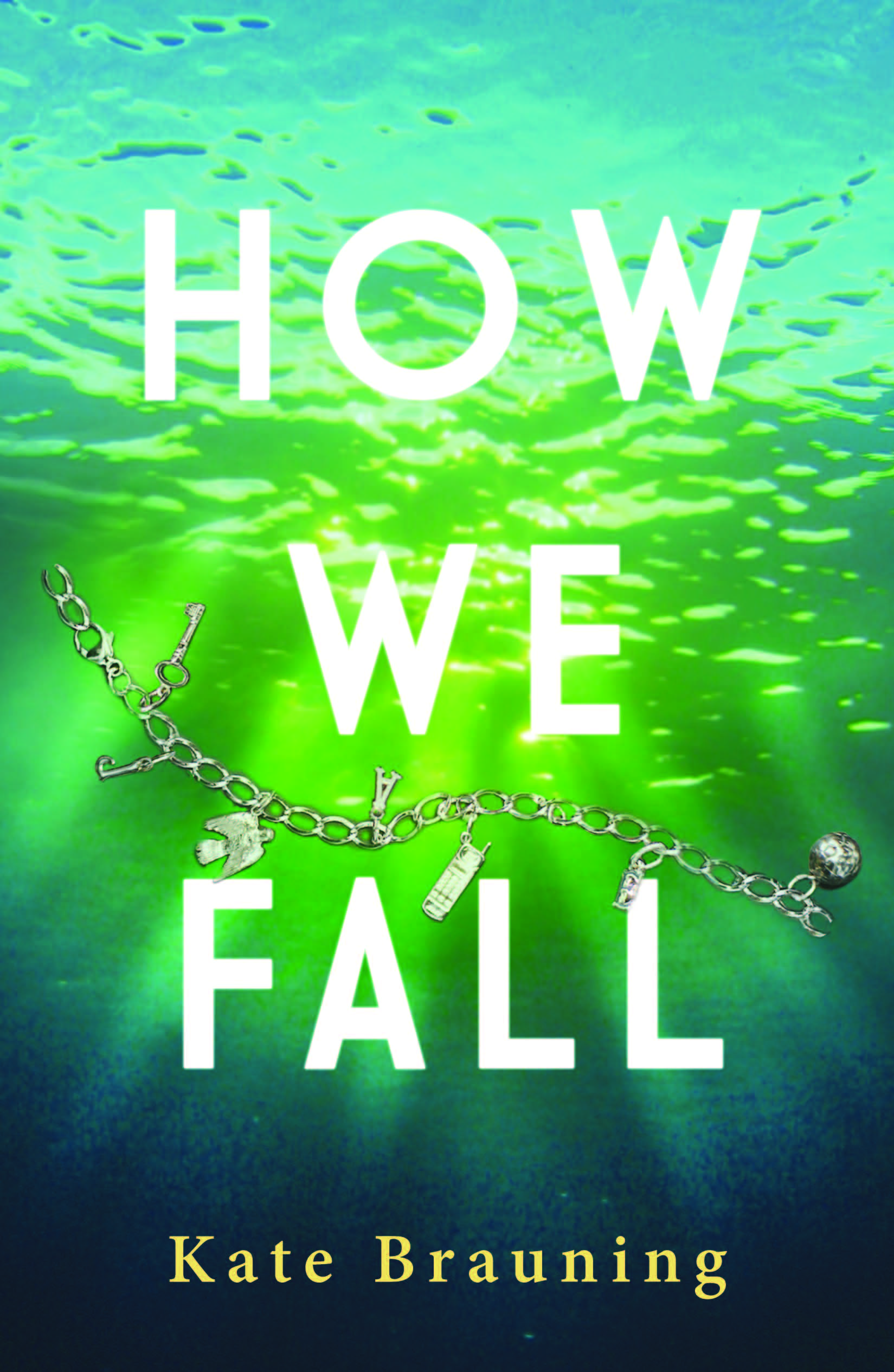
HowWeFallCover


Sneak Peek Page:

Chapter One
Last year, Ellie used to hang out at the vegetable stand with Marcus and me on Saturdays. This year, her face fluttered on a piece of paper tacked to the park’s bulletin board. Most weeks, I tried to ignore her eyes looking back at me. But today, Marcus had set the table up at a different angle, and she watched me the entire morning.

The day that photo was taken, she’d worn her Beauty and the Beast earrings. The teapot and the teacup were too small to see well in the grainy, blown-up photo, but that’s what they were. She’d insisted sixteen wasn’t too old for Disney.

The crunch of tires on gravel sounded, and a Buick slowed to a stop in front of the stand. I rearranged the bags of green beans to have something to do. Talking to people I didn’t know, making pointless small talk, wasn’t my thing. My breathing always sped up and I never knew what to do with my hands. It had been okay before, but now—surely people could see it on me. One look, and they’d know. Chills prickled up my arms in spite of the warm sun.

Marcus lifted a new crate of cucumbers from the truck and set it down by the table, his biceps stretching the sleeves of his T-shirt. Barely paying attention to the girl who got out of the car, he watched me instead. And not the way most people watched someone; I had his full attention. All of him, tuned toward me. He winked, the tanned skin around his eyes crinkling when he smiled. I bit my cheek to keep from grinning.

The girl walked over to the stand and I quit smiling.

Marcus looked away from me, his gaze drifting toward the girl. Each step of her strappy heels made my stomach sink a little further. Marcus tilted his head.

He didn’t tilt it much, but I knew what it meant. He did that when he saw my tan line or I wore a short skirt. I narrowed my eyes.

“Hi,” she said. “I’d like a zucchini and four tomatoes.” Just like that. A zucchini and four tomatoes.

Marcus placed the tomatoes into a brown paper bag. “Are you from around here?”

Of course she wasn’t from around here. We’d know her if she were.

“We just moved. I’m Sylvia Young.” The breeze toyed with her blonde hair, tossing short wisps around her high cheekbones. Her smile seemed genuine and friendly. Of course. Pretty, friendly, and new to town, because disasters come in threes.

“Going to Manson High?” Marcus handed her the bags.

She nodded. “My dad’s teaching science.”

Finally, I said something. “Three bucks.”

“Hmm?” Sylvia turned from Marcus. “Oh. Right.” She handed me the cash and looked over the radishes. “Are you here every day?” Her eyes strayed back to Marcus.

“Three times a week,” he said.

“I’ll see you in a day or two, then.” She waved.

I was pretty damn sure she wouldn’t be coming back for the radishes.

____

Pre-Order How We Fall: Books-A-Million, Barnes & Noble, Powell’s Books, IndieBound, Books Inc., Joseph-Beth Booksellers, Book Depository,
Amazon U.S., Amazon Canada, Amazon U.K., Amazon Germany, Amazon Japan.

Add How We Fall on Goodreads!


About the Author:

www.jenniophotography.com Kate spent her childhood in rural Missouri raising Siberian huskies, running on gravel roads, and navigating life in a big family. Now living in Iowa, she is married to a videographer from the Dominican Republic, and still owns a husky. She loves bright colors, fall leaves, unusual people, and all kinds of music. Kate has written novels since she was a teen, but it wasn’t until she studied literature in college that she fell in love with young adult books.  Kate now works in publishing and pursues her lifelong dream of telling stories she’d want to read. Visit her online, on Facebook, or on Twitter.


interview: Bethany Hensel

One of the things I love is talking with authors about how they approach writing and what they most loved about their books. Today I’m super excited to welcome Bethany Hensel to the blog to chat with her about her excellent book, UNSTOPPABLE.

Unstoppable tells the tale of young, intelligent and handsome Derek Archer, whose life is finally beginning. He’s just about to graduate from high school, land the job he’s always wanted, and move in with the girl he’s always loved, Victoria. There’s no reason for him to question or want for anything…until the day Victoria’s father is shot and killed, setting off a devastating, heartbreaking chain of reactions.

Now, the race is on, and Derek has only three days to right a terrible wrong. With the help of a childhood friend with a penchant for high-tech espionage, they investigate every lead, never imagining their search would take them deep into the heart of a seemingly perfect family, where old ghosts, bitter lies, and agonizing betrayal all collide. It’s then, with the lives of everyone he holds dear in the balance, Derek discovers just how unimaginable the truth can be…and how unstoppable.

Full of twists and turns, this breathtaking story is The Bourne Identity meets Baz Lurhmann’s Romeo and Juliet…expect action, expect danger, expect love.

Amazon | B&N | GoodReads | Bethany’s Site

Sounds awesome, right? (That’s because it is.) Bethany is a fantastic writer, and I’m thrilled to have her here talking about UNSTOPPABLE as well as the next book in her Truth and Love series, IRREVERSIBLE. Alright, let’s go!

Hey Bethany! When did you first know that you wanted to write books? Was it something you’ve always known or a talent you discovered along the way?

Hey Alex! Thanks for having me here! Excellent question. I love this interview already. 🙂 From a very young age, I loved to perform. I loved to dance and sing and tell stories. As I got older, the need to be an entertainer never diminished, though it took a while for me to figure out what medium I would go into. I think I was 16 or 17….maybe 18, when I read Harlan Coben’s Tell No One and it really changed my life. I decided, in that moment, I wanted to entertain a person the way Harlan Coben had entertained me with that story. So I wrote my first tale shortly thereafter and the rest is history.

I love how one book can just change everything like that. Awesome! The world of UNSTOPPABLE is one that I can just lose myself in— from the moment we meet Derek on page one, we know right away that he’s in an unforgiving place, but a place that he’s also learned to thrive in. What was the inspiration for that world?

Aw thanks so much! The world of Unstoppable is very much like this one. The only real change is the laws that govern the world. It’s a very strict place to be, and therefore, very scary. One false move and you’re done! That sense of urgency came from the fact that I wanted this story to hit the ground running and not stop. It was incredibly important to me that the stakes in Unstoppable were literally life and death.

I’m a big believer in pushing limits and experimenting as a writer. Was there a point in writing this that you felt you were pushing yourself or trying something new?

I thought I was a bit out of the box with the layout of the work, but no, I don’t think I got too experimental. 🙂 But then again, weirdness is in the eye of the beholder, so I’ll leave it up to the readers. 🙂

The pacing in UNSTOPPABLE is also top-notch. From one scene to the next, the action doesn’t let up until the very last page. How did you get that jump-off-the-pages energy in your work?

Whew! Glad you felt that way because that’s what I was going for! Like I said, Harlan Coben really changed my life and his books have been a huge influence on my writing. His stories are lean and mean and I wanted mine to read the same. I enjoy reading stories like that. Yes, I also enjoy reading very lush, lyrical books that take their time, but there’s something about a high-stakes cat and mouse chase that really entertains me.

So to ensure I wrote a lean, mean story, I had one rule in mind: nothing extra, nothing superfluous, nothing slow. If I thought a scene, chapter, paragraph, sentence or word began to drag the story, I cut it. I was merciless!! Trust me! It started out at 130,000 words and I chopped it down to about 66,000.

That sounds like some hardcore revisions! I am in awe. Alright, time for a process question. 🙂 Do you listen to music while you write, or do you have other writing rituals?

I listened to the Man of Steel soundtrack a lot! But if the story had a theme song, I’d say it was Bryan Adams Everything I Do, I Do it For You. That sums up the story pretty darn well!

Aahhh! I can so see that. What character in UNSTOPPABLE was the most fun for you to write, and why?

Victoria! I can’t say why because then I would spoil it, but she was a TON of fun! When you read the book, you’ll know instantly why. 🙂

I don’t want to spoil it either, but YES. I also loved Sabrina, and I’m so thrilled we get to hear more about her in IRREVERSIBLE. Can you tell us more about that story and maybe give us a hint about what we can expect?

Thanks Alex! Sabrina is one of my favorite characters! I love how tall and sassy she is. 🙂 As for what you can expect in Irreversible….humor, tons of verbal sparring, bathroom cat fights and slumber parties at Derek’s house! You will also find answers, especially the one to what happened that night. The book is a novella, but it’s jam-packed with twists and turns and a lot of surprises. It was a fun book to write and I hope it translates in the reading. 🙂

As a huge fan of both verbal sparring and slumber parties, I am super excited about it. *moves to top of TBR* And lastly, what is one piece of writing advice that you’ve learned from working on your books?

I’ve learned that it will come together. As long as I am patient, work hard and not give up, the story will come together. There were some hairy moments when I thought the book would never end or it would never gel and make sense. But that’s when I needed to be the strongest and push through the tough edits and have faith the story would all come together in the end. Sometimes, you make a mess of things when you write, and it’s hard to see the progress and good stuff going on underneath the mess. But it’s there. I’ve learned that if I just keep going, keeping sitting at the computer one day after the other, writing one word after the next (even if I’ll just end up deleting them later anyway) I’m making progress. The book is becoming better and that’s always been my goal. Write the best book I possibly can. 🙂

Great advice! As someone who’s also been through some dicey revisions, I love this. Persistence and diligence, guys. 🙂 Thanks Bethany for such a fun interview! 

on wisdom

before

When I was a little kid, I asked why they were called wisdom teeth.

I don’t really remember why we were talking about wisdom teeth, but I remember the answer: they came in when you were old enough to start being wise. I’m almost 25, and while that doesn’t really feel like I’ve reached a wise age (unless it’s the wiseass age), I’d still like wisdom teeth to teach me something about the human condition.

There are five stages in the Kubler-Ross model of grief: denial, anger, bargaining, depression, acceptance. And sure, maybe busting out the grief cycle is a little extreme for a routine oral surgery. But there’s a reason people have nightmares about losing teeth– it’s a metaphor for death. Without teeth, we’re toothless: on a primitive level, we can’t hunt and feed ourselves well–we become the weak in the herd. It’s a change in yourself that you will never be able to undo, one more sign of memento mori as you leave teenage invincibility

It’s always bothered me that anger is in the middle of the cycle.

I don’t think that anger is just one of many opposites to happiness. Look at any middle school emotion chart, and in all those smiley faces expressing different feelings, there’s maybe one or two that look okay/socially acceptable to be. Everything else is an uncomfortable contortion of features. In my experience, emotions are less polar and more overlapping. Anger doesn’t preclude happiness, and to me, it’s never been its opposite.

But still, we get taught that there’s a very limited number of okay moods to be and that everything else is negative, is something you don’t want to be because it is Not Happy.

I like anger. Maybe it’s something about being a girl that makes people think your anger is not the same kind of anger they’re talking about. Or maybe it’s just that happiness and anger are ingrained as such opposites that it seems impossible for them to coexist.

But they do. Tintin‘s Captain Haddock is hilariously angry but, I’d like to think, is at his heart also a happy person. He just wants things done a certain way (preferably his way, aka the best way, and with whiskey). When both those conditions are met, he’s on cloud nine. Professor Calculus also toes this line– a type A, obsessive personality who is happily whimsical up until the point where someone calls him a goat or intimates that he’s not as smart as he thinks he is. If my French comic book references aren’t reaching you, then think about Stubb in Moby Dick.

When I first thought about passing through the anger part of the grief cycle when we learnt it in 9th grade religion class, I thought it meant losing a integral part of myself. (And if loss of the self doesn’t spiral you straight into depression stage, I don’t know what will.)

But having gone through denial (my wisdom teeth are already in, this tooth chart on the internet is just wrong), bargaining (I’ve had a root canal, I brush my teeth three times a day, this can’t be happening), depression (I am going to have to relive the most terrifying experience of my life), acceptance was a surprise.

I’m not not-angry– it’s just a different flavor of anger. After googling “human teeth diagram” (as you do when you’re a tech-savvy twenty-something living away from home) and counting my own out, I was angry in the sense that I was frustrated I couldn’t change what was happening to me.

And that I think is what the Kubler-Ross model is talking about. Anger as rage at powerlessness, refusing to accept what you know in your gut is true. Frustration.

I’m frustrated at the human body for being so poorly designed that its own teeth run into each other, and I’m ticked off that us humans, as possessors of bodies, have not figured out a better way to deal with wisdom teeth by now. That’s the part of anger that I’ve moved past. Whatever happens, the teeth still have to come out and that’s not changing.

What I haven’t moved past is anger at my fear. Vita brevis, ars longa, right? Maybe fear is always going to be my first reaction with dental stuff, or any surgery– it is for a lot of people. I don’t like it. Fear is weakness, and being scared of a dentist, aka someone whose job is to help you, is a stupid fear.

But, at the same time I’m happy for the perspective, happy I get what people mean when they say to stay hungry, stay foolish. You have a whole lot of things to do, and a much shorter amount of time to do them in. It’s not something I like about being human, but it’s something I’d rather know than not.

a few hours post-op

I got a very kind, thoughtful email from one of my professors wishing me “good luck with the teeth removal.”

I’m working on my second chocolate frosty since my wisdom teeth came out. It’s slow going since I can’t open my mouth much, but it’s happening. The night before the surgery I stayed up until 4am working on a manuscript and annoying a too-loyal Siberian Husky with a few hours of motivational heavy metal, so now the wolf dog and I are kicking back on the couch again, me with this frosty and him curled up into a little ball, sleeping it off.

Most of what I’ve learned from this is that no one really knows what to say about having your wisdom teeth out. My officemates and CPs shared their experiences, my little brother told me about how much blood he coughed up, and my grandmother phoned to express her well wishes and wonder why the Good Lord gave us extra teeth. I said that maybe the Good Lord was just looking out for the dental hygienists in His flock, but she encouraged me to think in less worldly terms.

“It’s just something that happens to everyone,” my mom said in the oral surgeon’s.

“Great, wisdom teeth and death.” I said. “Thanks, I am so less depressed now.”

“That’s not what I meant.” She smiled, then checked again to make sure I’d taken my contacts out before the surgery. “You’re going to be fine. Everybody has to go through this. It’s part of being human.”

My dad had been pretty silent on the wisdom teeth front, and I didn’t really mind. Between us, Dad and I make up the most oral surgery and dental weirdness in the household, and I took his not bringing up my teeth as a sign of stoic respect. Warrior to warrior, the last, grim salute before you ride into battle.

But still, since it’s a human thing and since I try to catalogue human things, after I got home from the surgery I decided to ask him. I knew my mother’s story, my grandmother’s, my little brother’s, and the ones my friends online and in the office had shared. I wanted to know his.

“They never came in.” My dad shrugged over some diagrams for a new research study he’s putting together at work.

“What?”

“Yeah. My wisdom teeth just never grew in. Never got ’em. They’re not even on my x-rays. I didn’t want to mention that until after you were finished getting yours out.” He ruffled my hair. “But I’m proud of you for being brave, kiddo.”

Right now, I’m planning out tomorrow’s soft food banquet, scowl-smiling at the nine different, dessert-flavored varieties of yogurt I’ll be dining on for the next few days. If I’ve learned anything from this, if there is wisdom in these wisdom teeth, it’s that I’m pretty damn lucky.

I’m lucky I have friends who tell me about their own hilarious mishaps with these things, classmates who cover my recitations during my x-rays, professors who take the time to wish me well, a mother who trails after me with gauze and hits up every smoothie place in town for chocolate shakes, and a family who’s 100% cool with me locking myself up in the den to make terrible things happen to this poor fictional guy as I recover.

I’m making art and studying what I love. I have a fridge full of yogurt, a very clingy husky, and know some of the coolest people around. And for all that, and all the stories, thanks.

mash-ups


I think if I had to characterize SLINGS AND ARROWS, it would be as a mash-up.

The first time I listened to a mash-up was sometime in late high school (look at that YA go). It was on my radio–because I’d gotten a radio for graduating eighth grade, like a boss– and it was the famous Green Day/Oasis one. It was pretty cool– taking two things that really did not match at all, and then combining them and making them work. Now mash-ups are super common– you can blitz through soundcloud and come up with Bastille vs. Katy Perry, and somehow, magically, the sound holds.

Sometimes, it even makes more sense than the original songs separately. Whenever “Boulevard of Broken Dreams” comes on the radio when I’m driving, I sing the Oasis part to fill in the gaps (and then bust out a little Eminem at the end, naturally) because it just sounds weird to me now without it.

S&A is a story told in two timelines. It’s the first time I have ever done this, and I don’t really remember what made me do it. Dual timelines is a lot like having dual POVs– at first, I was much worse writing Dominic’s past self (let’s call him GreenDay!Dom) than his present self (Oasis!Dom). I didn’t know enough about who Dominic was as his own person– he literally started out as a grief writing exercise, and his grief was defined by one person, Shelley.

I’ve always really admired fugues. Fun fact: I learned the word fugue at age 15 when I read THE BEEKEEPER’S APPRENTICE (it was my favorite book and it remains in a place of honor on my shelf today). Because mispronouncing things in front of my mum is a recurring motif in my life, I said how cool I thought fugues were and she cracked up because “fug-way” is not how you say “foog.”

(I did the same thing with balsam. “Oh honey, it’s ‘bal-sum,’ not ‘ba-sawm.'”)

Telling a story in two parts has been a trick that I’ve wanted to imitate for a while, and it feels pretty satisfying to get to do it. I feel like fugues are going to be a part of my writing always, even though I don’t plan on ever ever ever my god doing dual timelines again. I remember that enthusiasm I felt as a teenager reading stories and freaking out when I realized what the author was doing, and one of the first times that happened was with fugues.

Sometimes it feels like my life is one big mash-up. I do math and I do writing, and I try to find the commonality between them (hint: it’s truth). And this is what I love, when I can use some ridiculous writing trick I learned from my favorite teenage book to pull massive shenanigans in a manuscript years later. This is why I write.